/// Share this article
Hiring a web design company in India can make excellent business sense for a US company.
But the decision should not begin with one question:
“How much cheaper is an Indian web design company?”
A better question is:
“How well will this company understand my business, and how responsibly will they build and manage my website?”
After more than 25 years working across web design, development, SEO and digital strategy-and working with international clients since the early 2000s-I have learned that the difference between a successful website project and a frustrating one rarely comes down to geography.
It comes down to how the people behind the project think.
So, rather than writing another generic guide about hiring an offshore web development company, I wanted to answer a more practical question:
What should a US business actually expect from a serious web design company in India?
Start With the Business, Not the Website
When a client tells me, “We need a new website,” I don’t immediately start discussing colors, technology, pages or animations.
I want to understand why they need the website in the first place.
Is the website simply going to establish an online business presence?
Is it expected to generate leads?
Is the company trying to grow locally, nationally or internationally?
Is it selling products online?
Does the business need ecommerce, bookings, memberships, subscriptions or some other functionality?
Then I want to understand the business itself.
What products or services does it offer?
What are its current challenges?
Who are its customers?
Are there competitors the client particularly likes?
And if they like a competitor’s website, what exactly do they like about it?
This conversation establishes the foundation for everything that comes afterward.
A corporate coach, for example, might say:
“I need a modern website for my corporate coaching business.”
That could mean a relatively straightforward business website.
Or it could mean a much larger platform involving online education, memberships, payments, scheduling, courses and ecommerce.
The sentence is the same.
The project isn’t.
That’s why requirements cannot always be extracted from a form. Sometimes the client knows exactly what they need. Sometimes they need guidance to discover what they actually need.
A good web consultant should be comfortable doing both.
For more on this philosophy, see our approach to web design and development.
A Website Is Not the Objective
This is probably the most important principle I have developed over the years:
The website is not the objective.
The website is a tool.
The real objective might be generating qualified enquiries, selling products, attracting applicants, establishing credibility, supporting an existing sales process, educating customers, or creating an online platform around the business.
That changes how the website should be designed.
A beautiful website that doesn’t help the business achieve its objective is still a poor business investment.
This is also why I don’t believe in starting every project with a predetermined technology stack.
First understand the business.
Then determine what the website needs to accomplish.
Then decide what needs to be built.
And only then decide how it should be built.
Don’t Judge a Website by Its Looks Alone
I enjoy good design. I care about colors, typography, interface design, animations, spacing, imagery and visual polish.
But a website can look fantastic and still perform badly.

Google doesn’t care whether a website uses black or white backgrounds. Users don’t visit a website because it has a particular glassmorphism effect.
They visit because they need something.
They want information.
They are comparing options.
They want to know whether they can trust the business.
Or they are ready to buy.
The first few seconds matter enormously.
A visitor should quickly understand:
What does this company do?
Is this relevant to me?
Can I trust this company?
What should I do next?
That is why I think of the websites we build as conversion-focused from the ground up.
The visual design should support the communication rather than distract from it.
SEO Should Begin Before the First Line of Code
One of the biggest misconceptions about web design is that SEO is something you “add” after the website has been built.
I don’t see it that way.
SEO is active before the first character of code is written.
Before development begins, we think about the website’s architecture.
The homepage.
Services.
About.
Blog.
Legal pages.
Breadcrumbs.
Internal linking.
Structured data where relevant.
URL structure.
Content architecture.
Performance.
Search intent.
The technical foundation matters because search engines need to understand what a website is about and how its pages relate to each other. Google itself provides extensive guidance around search visibility, technical requirements and Search Essentials.
This is also why we don’t sell “SEO-friendly development” as some magical add-on.
The websites we build are designed with search in mind by default.
That doesn’t mean we promise rankings.
It means we don’t intentionally build a website in a way that creates unnecessary obstacles for search engines.
Performance matters too. Google’s Web Vitals initiative focuses on user experience signals around loading, interactivity and visual stability, including the Core Web Vitals.
So our approach is performance-first rather than adding performance optimization as an afterthought.
And no, that doesn’t mean filling the website with AI-generated content simply because AI can produce thousands of words.
Don’t Destroy an Existing Website’s SEO Value During a Redesign
An existing website is a very different project from a new website.
I take redesigning an old website very seriously.
Why?
Because an established website may have years of accumulated search visibility, backlinks, indexed URLs, content, references and user familiarity.
You cannot simply dismantle it and start again as though nothing existed before.
Before the old website is replaced, there should be a proper migration plan.
Which pages are important?
Which URLs have search visibility?
Which pages should remain?
Which URLs are changing?
What happens to old content?
Where should old URLs point?
If an old URL such as:
example.com/?page=06
is being replaced by a meaningful URL such as:
example.com/services/consulting
the migration needs to account for that change.
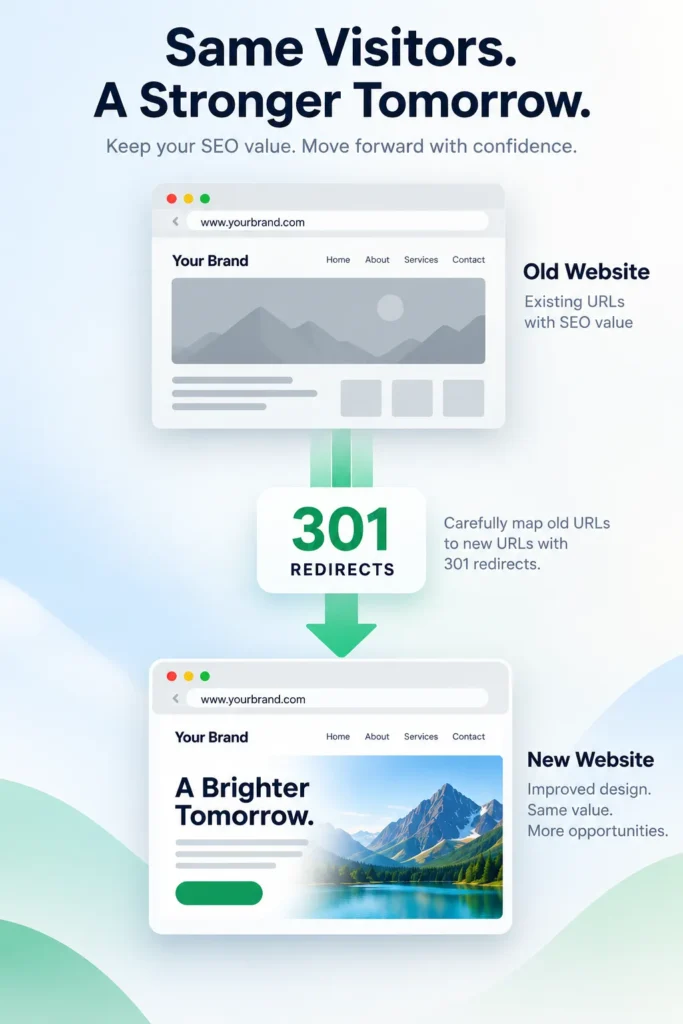
Permanent redirects are an important part of a migration. Google specifically recommends permanent server-side redirects such as 301 or 308 when a page has permanently moved.
The principle is simple:
A redesign should improve the website without accidentally destroying the digital value that already exists.
This is one reason our website investigations often look far beyond the current visual design. A website has a history.
And that history matters.
For example, our investigation into a long-running website’s SEO, UX and URL changes illustrates why seemingly technical decisions can have consequences well beyond the design itself.
Technology Should Follow the Business
There is a temptation in web development to choose technology because it is new, fashionable or technically impressive.
I don’t think that is a good reason.
Suppose a small business needs a few pages:
- Home
- About
- Services
- Contact
- Legal pages
There may be no reason to build a complicated custom platform.
A standard CMS such as WordPress may be perfectly appropriate.
Now change the requirement.
Suppose the client needs a custom car-rental booking system with functionality that standard CMS plugins cannot reasonably provide.
That changes the technology decision.
Or imagine a business wants to create a gemstone marketplace where users can register, verify accounts and list gemstones for sale.
Now we’re talking about a much more sophisticated platform involving users, listings, verification, ecommerce and business-specific workflows.
The technology should reflect that requirement.
The newest technology is not automatically the right technology.
Experience is partly knowing what you can build.
But it is also knowing what you don’t need to build.
Conversion Doesn’t Mean “Put a Contact Button Everywhere”
Websites receive different types of visitors.
I generally think about three broad categories.
Type 1: “I’m learning.”
The visitor is researching a product, service or problem.
A useful blog can help this person understand the subject and discover the business.
Type 2: “I’m comparing.”
This person already understands the product or service and is looking at different options.
This visitor needs detailed, credible service or product information.
They need to understand what the company offers, why it matters, what makes it different and whether it appears trustworthy.
Type 3: “I’m ready.”
This person is ready to buy, enquire, book, sign up or take the next step.
The website should make that next step obvious.
The mistake is designing the entire website around Type 3.
Not everybody is ready to contact you immediately.
A good website creates useful doors for all three.
Educate the first visitor.
Help the second visitor evaluate you.
Make it easy for the third visitor to act.
When those first two layers are done properly, the third becomes much more natural.
A Website Should Represent the Real Business
A website is, in many ways, the digital mirror of a physical business.
And this creates an interesting problem.
Over 25 years, I have seen all kinds of businesses.
There are businesses that are genuinely excellent but have websites that badly underrepresent them.
And there are businesses that are not nearly as impressive as their websites make them appear.
A website should not manufacture credibility that doesn’t exist.
It should communicate the genuine credibility that does.
That means accurate information.
Real experience.
Good products or services.
Authentic testimonials and reviews where appropriate.
Clear information.
Professional presentation.
Useful content.
And a straightforward way for a potential customer to contact the business.
For businesses marketing to US consumers, truthfulness matters beyond SEO. The Federal Trade Commission states that advertising claims should be truthful, non-deceptive and supported by evidence.
Our job is not to make a mediocre business look extraordinary.
Our job is to present a genuine business properly.
Talk to the People Behind the Website
If you’re considering several web design companies in India, don’t evaluate them entirely through email.
Have a video call.
Look at the portfolio, certainly.
Read the case studies.
Read their published articles.
Look at their reviews.
But then talk to the people.
You will learn things from a conversation that you cannot learn from a portfolio.
Do they listen?
Do they ask questions?
Are they genuinely interested in your business?
Do they challenge your assumptions when necessary?
Do they understand what you’re trying to accomplish?
Or are they simply trying to get you to approve a proposal?
Anybody can have a good-looking website these days.
The harder thing to manufacture is genuine involvement.
I have always believed that asking unusual questions can sometimes be a sign that someone is actually trying to understand your business rather than simply collecting requirements.
A Consultant Should Be Willing to Say “No”
If a client comes to me with a specific idea and, after understanding the business, I believe that idea isn’t appropriate, I believe it is my responsibility to say so.
Politely, of course.
But honestly.
Otherwise, why call yourself a consultant?
A consultant shouldn’t simply execute every request without thinking.
The responsibility is to tell the client what appears to be good, what appears problematic, and why.
Sometimes that means recommending something different from what the client initially asked for.
Sometimes it means recommending a smaller project.
And sometimes it means saying:
“You don’t actually need this.”
That last sentence might mean less revenue for the agency.
That’s okay.
I would rather lose a project than sell something a client doesn’t need.
Ownership Should Stay With the Client
There is another principle I feel very strongly about:
The client should own their website.
The client is paying for their work.
A website isn’t a SaaS subscription where the agency owns the underlying business asset.
The client should have control over the important components of their digital presence, including where applicable:
- Domain
- Hosting
- Website
- Source code
- CMS/admin access
- Google Analytics
- Google Search Console
- Relevant licenses
- Other accounts and services paid for by the client

I strongly dislike the practice of holding a client’s domain, hosting or website access hostage so that the client has to keep paying the original agency for every modification.
That may create recurring revenue.
It doesn’t create trust.
Give the client control.
Then earn their continued business because they want to work with you.
Working With an Indian Web Company From the US: Communication Matters
My experience working with US clients goes back to 2003, when I began working with a Los Angeles-based web design company on SEO projects.
One of the earliest lessons I learned was about punctuality.
A 4:00 PM meeting meant 4:00 PM.
Not 4:10.
Not 4:15.
That may sound trivial, but it taught me something much bigger:
Professional expectations are not universal.
Different markets can have different expectations around time, communication, responsiveness and accountability.
If an Indian company wants to work seriously with US clients, these things cannot be treated casually.
Be punctual.
Communicate clearly.
Take ownership.
If there is a problem, say so.
If a deadline is at risk, communicate before the deadline – not after it.
And understand that the client is not simply buying technical work.
They are buying a working relationship.
Don’t Accept Projects You Cannot Deliver
This is another area where I think the industry has a serious problem.
Some companies accept projects before they are genuinely confident they can deliver them.
The invoice gets raised.
The client pays.
Then the company figures out how to execute the project afterward.
Sometimes parts of the project are outsourced to freelancers.
Something goes wrong.
The client doesn’t know who actually did the work.
But the agency is still responsible.
I don’t believe that’s ethical.
A web design company should accept projects that it is genuinely capable of delivering.
It is better to lose a project than accept money for work you aren’t equipped to execute properly.
And if something unexpected happens during a project, there is an important distinction.
If the client changes the scope or requests significant new functionality, that can affect the timeline and cost. Discuss it transparently.
If the problem is a bug caused by the agency’s own work, that’s different.
Own it.
Fix it.
Don’t make the client pay for your mistake.
What Happens After the Website Goes Live?
We don’t really call it “finished.”
We call it handover.
The website goes live, the appropriate analytics and Search Console setup is completed, and depending on what the client has signed up for, the project moves into its next phase.
All website projects should also account for bug fixing. Bugs resulting from the development work are part of delivering the project properly.
Beyond that, maintenance depends on the website.
A simple business website and a complex ecommerce platform obviously have very different maintenance requirements.
But I don’t think businesses should assume that websites are maintenance-free.
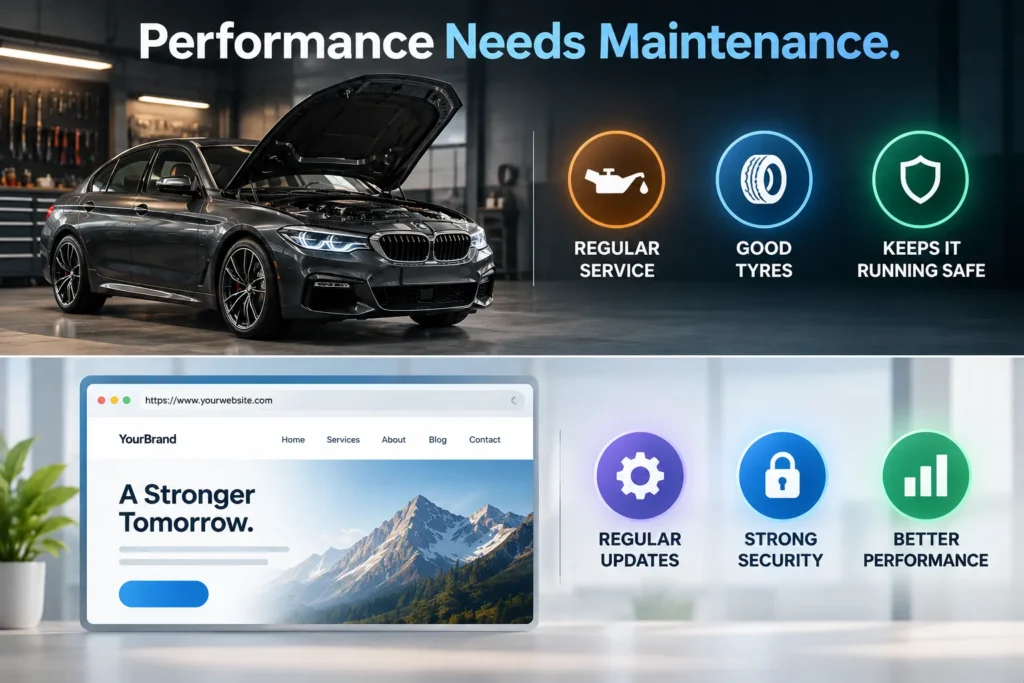
Think of it like a car.
You don’t buy a car and assume it will never need maintenance again.
A website is no different.
Software changes.
Browsers change.
Security requirements change.
Third-party services change.
Content changes.
Business requirements change.
A website should be maintained according to its complexity and importance to the business.
Quality Doesn’t Have to Mean the Same Price
One of the reasons US businesses consider offshore web development is cost.
That’s perfectly understandable.
But I don’t think the conversation should be:
“How cheap can I get a website from India?”
The better question is:
“Can I get the quality, communication, accountability and technical capability I need from an Indian team at a commercially sensible cost?”
The lower invoice amount does not automatically mean lower quality.
Indian companies operate in a different cost environment from companies in the United States. That can create a meaningful pricing difference while still allowing a capable team to deliver professional work.
For the client, the real requirements are usually straightforward:
Good quality.
Clear communication.
Timely delivery.
Technical competence.
Trust.
Accountability.
Those things matter regardless of where the web company is located.
So, What Should a US Business Look For?
There isn’t one universal checklist that determines whether an agency is right for every business.
Different clients value different things.
Some will care heavily about design.
Some will care about case studies.
Some will care about SEO experience.
Some will look closely at reviews.
Some will prioritize technology.
Others will care most about communication.
But there is one thing I would encourage every prospective client to do:
Talk to the people behind the website.
Ask questions.
Explain your business.
See whether they listen.
Tell them what you think you need and see whether they simply agree – or actually think about it.
Ask how they approach an existing website.
Ask what happens to your URLs during a redesign.
Ask who owns the domain and hosting.
Ask how SEO is incorporated.
Ask what happens when something goes wrong.
Ask what happens after launch.
And most importantly:
Pay attention to whether they seem genuinely invested in understanding your business.
Because that is difficult to fake over the course of an actual project.
The Country Isn’t the Quality Filter. The Process Is.
A good web design company in India doesn’t need to compete with US companies by pretending to be a US company.
It needs to compete on what actually matters:
Understanding the business.
Listening before speaking.
Asking difficult questions.
Choosing appropriate technology.
Building with search and performance in mind.
Protecting existing digital assets.
Designing around user intent.
Giving clients ownership.
Communicating honestly.
Taking responsibility.
And knowing when to say, “This isn’t what you need.”
After more than two decades in this industry, my philosophy has become surprisingly simple.
I don’t believe the goal is to sell the client the biggest website possible.
I don’t believe every project needs the newest technology.
I don’t believe SEO should be bolted onto a website after development.
I don’t believe a beautiful interface automatically means a successful website.
And I certainly don’t believe a client should be trapped by the company that built their website.
Understand the business.
Solve the right problem.
Build what is actually needed.
Protect what already exists.
Give the client control.
And deliver honestly.
That is what I believe a professional web design company – whether in India, the United States, or anywhere else – should do.
A note on standards and usability
There is also a broader technical responsibility that shouldn’t be overlooked. Web accessibility is an international web standard, with W3C’s WCAG 2.2 providing guidelines around making web content accessible to people with disabilities.
Accessibility, performance, search visibility, usability and conversion aren’t isolated disciplines. They overlap.
And that is ultimately why I don’t look at a website as merely a collection of pages.
I look at it as a business asset.
If you are considering a new website, redesign or custom web development project, you can learn more about our web design approach or contact Web Design India to discuss what your business actually needs.
/// Share this article
/// More web design reading