/// Share this article
What happens when a consultant is expected to deliver results without controlling the decisions, systems and execution that determine those results.
There is a sentence that sounds perfectly reasonable in a business conversation:
“I want results.”
Of course you do.
If you’re paying a web designer, SEO consultant, marketing consultant, business strategist or agency, you don’t want a beautifully formatted report sitting in your inbox. You want the business to move.
More enquiries.
Better visibility.
More customers.
Better positioning.
More revenue.
Whatever the actual objective may be.
But there is a problem that both clients and consultants sometimes discover after the engagement has already begun:
What if the person responsible for the result doesn’t control the things that determine the result?
Welcome to the Accountability Trap.
And this is one of the most uncomfortable lessons I’ve learned from working on the web for more than two decades.
The project that made me think about this
Recently, I had a conversation with a potential client whose business was built around personal expertise.
The business already had an established personal brand, an existing website, one-to-one work, advisory/coaching services and a body of professional experience.
But there was a much bigger commercial question sitting underneath it.
Could that expertise be expanded beyond individual clients into areas such as:
- executive coaching and advisory
- leadership development
- team programmes
- corporate training
- professional communication programmes
- workshops
- keynote speaking
- corporate events
- organisational programmes
- customised engagements
In other words, this wasn’t simply a “build me a website” project.
It was potentially a business-positioning, website, content, SEO and market-development project.
The challenge was figuring out how to create a digital presence that could accommodate both sides of the business: someone looking for one-to-one coaching, and an HR leader looking for a workshop for 30 employees, a CEO looking for executive advisory, or an event organiser looking for a speaker. That broader multi-audience approach was actually the central idea behind the strategy I proposed.
And that distinction matters.
Because when a business is trying to move from “I sell my expertise to individuals” toward “I can potentially sell my expertise through multiple engagement models”, the website is no longer just a brochure.
It becomes part of the business-development infrastructure.
The website needs to explain the expertise, establish credibility, separate different audiences, present different ways of engaging, create appropriate conversion paths and eventually help us learn which opportunities the market actually responds to.
I was therefore not looking at the project and thinking:
“Nice website. Let’s change the colours and do some SEO.”
That would have been wonderfully easy.
It also would have missed the point.
The website already had a polished visual presentation. The question I was asking was much more fundamental:
“Does the current digital presence communicate all the commercial opportunities this person could realistically pursue?”
And after studying the business, I didn’t think the problem could honestly be reduced to:
“Let’s do some SEO.”
That would have been the easy thing to sell.
It just wasn’t the thing I believed needed to happen first.
The website wasn’t necessarily bad
This distinction matters.
A website can look good and still be strategically wrong for the business it is supposed to support.
That’s a completely different diagnosis from:
“Your website sucks. Give me ₹X and I’ll fix it.”
The existing website had a premium visual presentation and communicated expertise.
But I believed the larger commercial opportunity wasn’t being communicated clearly enough.
The business could potentially serve several different audiences and engagement models:
- individuals
- executives
- founders
- teams
- organisations
- workshops
- programmes
- speaking engagements
- events
- advisory work
The question wasn’t:
“Should this become a corporate website instead?”
The question was:
“Can the digital presence accommodate the different markets without confusing the visitor?”
That distinction became the foundation of my proposal.
The proposal explicitly recommended creating a broader platform rather than forcing the business into either “individual” or “corporate” positioning.
So I did what I normally do
I went deep.
Instead of throwing together a three-page SEO proposal, I looked at:
- positioning
- audience architecture
- services
- commercial opportunities
- website structure
- conversion journeys
- content
- SEO
- authority building
- speaking opportunities
- programmes
- market validation
- longer-term intellectual property
The proposal was built around the idea that the website shouldn’t simply be a digital brochure.
It should become a platform for discovering what the market actually responds to.
That meant testing different opportunities instead of pretending that we already knew which one would become the biggest revenue channel.
That philosophy was explicitly built into the proposed 90-day approach: discovery first, positioning and website strategy next, then market activation and validation.
And I deliberately didn’t promise:
“You’ll make ₹X.”
Or:
“You’ll get 100 leads.”
Or:
“You’ll rank #1.”
Or:
“You’ll definitely get corporate contracts.”
The proposal specifically stated that revenue, lead volume, rankings, corporate contracts, speaking opportunities and media coverage could not responsibly be guaranteed.
Because that’s not how serious consulting works.
Then we reached the interesting part
The client had previous experience with expensive marketing work that, from their perspective, hadn’t produced the expected results.
That matters.
If you’ve already spent a substantial amount of money on marketing and don’t believe you received meaningful results, you’re naturally going to be cautious about spending again.
That’s not stupidity.
That’s not irrationality.
That’s not even necessarily distrust of consultants.
It’s a completely understandable reaction:
“Why should I spend more money when the last person didn’t produce what I expected?”
And this is exactly where the relationship between client and consultant becomes important.
Because there are actually two different questions hiding inside that sentence.
Question 1:
Is the consultant’s strategy good?
Question 2:
Does the consultant have enough control to execute that strategy properly?
Those are not the same thing.
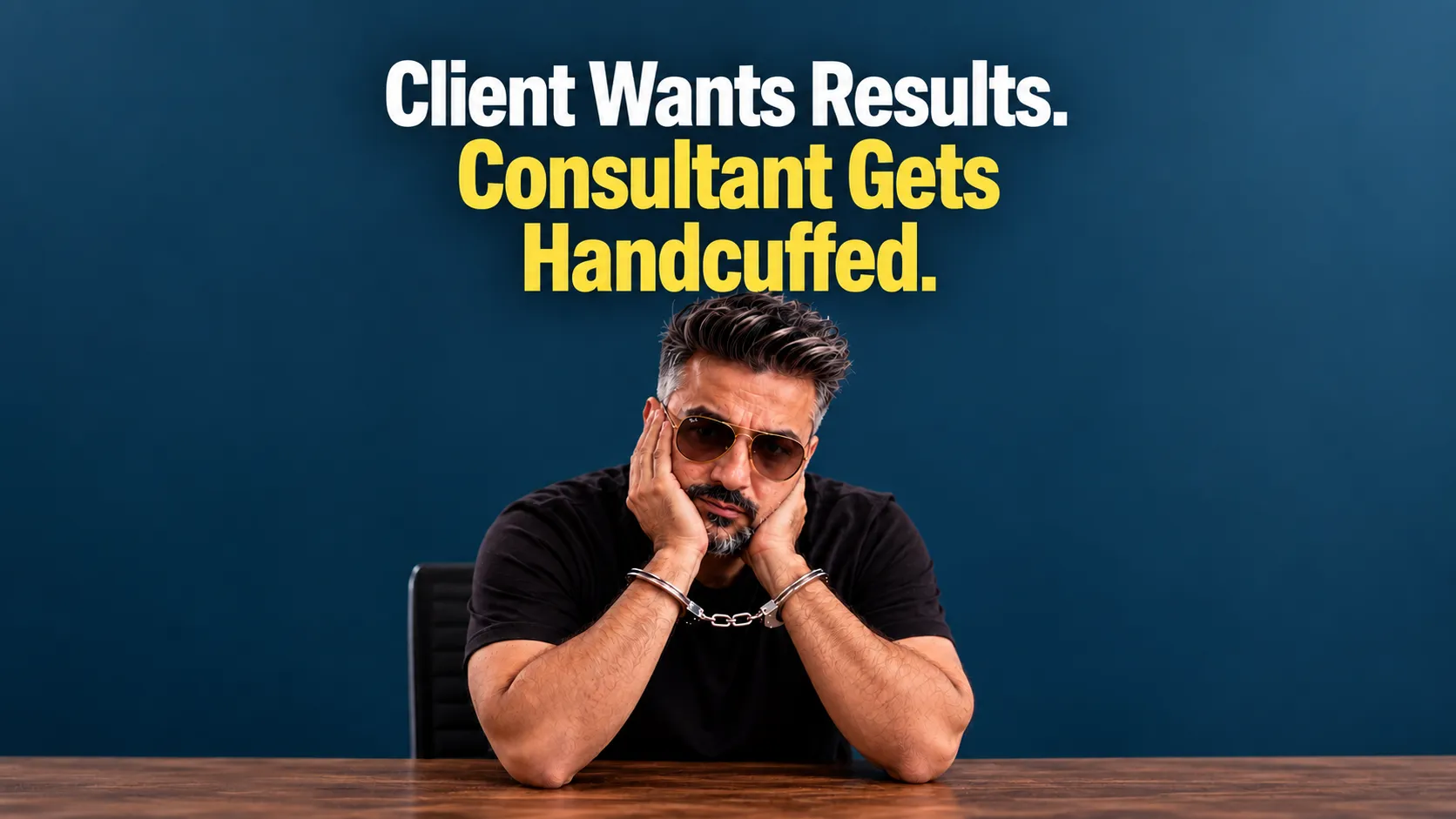
Here’s where the handcuffs appear
Imagine you hire an SEO consultant.
They identify technical problems.
But they cannot change the website.
They identify conversion problems.
But they cannot change the landing pages.
They recommend new content.
But somebody else decides what gets published.
They recommend changes to navigation.
But another developer controls the site.
They identify tracking problems.
But they can’t access analytics.
They recommend a new positioning strategy.
But the existing website remains untouched.
They recommend experiments.
But nobody implements them.
And then, three months later:
“So… where are my results?”
That’s the moment the consultant discovers the handcuffs.
And here’s the uncomfortable truth
The client may have done nothing wrong.
They have every right to say:
“I want to keep my website.”
They have every right to say:
“My existing developer will make the changes.”
They have every right to say:
“I don’t want a complete redesign.”
They have every right to control their own business.
Absolutely.
The consultant doesn’t own the business.
The client does.
But the consultant also has a right to say:
“If I’m being held responsible for the outcome, I need sufficient control over the things that influence the outcome.”
That’s not arrogance.
That’s basic accountability.
Responsibility must follow control
This is probably the single most important lesson in the entire story.
If I’m hired to provide strategy, I’m responsible for the quality of my strategic thinking.
If I’m hired to build the website, I’m responsible for what I build.
If I’m hired to implement SEO, I’m responsible for the work I actually control.
If I’m hired to deliver a specific business outcome, the situation becomes much more complicated.
Because business outcomes depend on many things:
Strategy + execution + budget + product + pricing + market demand + sales + positioning + website + content + distribution + competition + timing + client decisions.
One person rarely controls all of those.
So promising an outcome while controlling only one tiny piece of the machine is dangerous.
For everyone.
The Consultant’s favourite sentence should sometimes be:
“I can’t responsibly promise that.”
That’s not a weak consultant.
That’s often the responsible one.
If someone says:
“I guarantee you’ll rank #1.”
Ask yourself why.
Google doesn’t work for them.
Neither does the competition.
Neither does the market.
And certainly not the algorithm.
Likewise, if someone promises:
“I’ll guarantee you corporate clients.”
Ask how.
What happens if:
- the offer isn’t attractive?
- the pricing is wrong?
- the market doesn’t respond?
- the client doesn’t follow through?
- the sales process is weak?
- recommended changes aren’t implemented?
- the business takes three months to approve everything?
A consultant can influence these things.
A consultant cannot control reality.
But clients have a responsibility too
This is the part that often gets missed.
The consultant isn’t the only person who needs to understand accountability.
A client hiring an external expert should ask:
“What exactly am I hiring this person to control?”
If the answer is:
“Strategy.”
Then judge them on strategy.
If the answer is:
“Website development.”
Judge them on the website.
If the answer is:
“SEO implementation.”
Judge the actual SEO work.
If the answer is:
“Business growth.”
Then you need to have a much bigger conversation about access, authority, implementation, decision-making and measurement.
Because saying:
“You are responsible for growth”
while simultaneously saying:
“You cannot change the website, content, positioning, campaigns, tracking or implementation”
isn’t really a growth engagement.
It’s a growth recommendation engagement.
And those are very different products.
Here’s another trap: the invisible work
A lot of strategic work doesn’t immediately produce a shiny dashboard.
Suppose the first month involves:
- understanding the business
- interviewing stakeholders
- researching competitors
- analysing positioning
- restructuring offers
- designing the website architecture
- defining audiences
- determining content territories
- identifying acquisition channels
- establishing measurement
- deciding what not to do
There may be very little to show in a traditional SEO report.
No exciting:
“Congratulations! We published 37 posts!”
😂
But that doesn’t mean nothing happened.
Sometimes the most valuable thing a consultant does is prevent a business from spending six months doing the wrong thing.
The proposal I prepared deliberately framed the first phase around discovery and validation rather than blindly executing a predetermined marketing checklist.
And sometimes the consultant’s job is to say:
“Don’t spend money on SEO yet.”
This sounds insane if your business sells SEO.
But it’s one of the most important credibility tests.
If the website architecture, positioning, offer, conversion journey or business model is fundamentally unclear, pouring money into SEO can simply produce more visitors arriving at a confused destination.
Traffic isn’t the same as business.
A ranking isn’t the same as a customer.
A website isn’t the same as a business model.
And a beautifully designed website isn’t automatically a commercially effective website.
SEO needs somewhere worthwhile to send people.
The website should be part of the machine
A good website doesn’t merely answer:
“Who are you?”
It should also help answer:
“Why should I care?”
“Is this relevant to me?”
“Can you solve my problem?”
“How can I work with you?”
“Why should I trust you?”
“What happens next?”
And different visitors may need different answers.
An individual might want coaching.
An HR leader might want a workshop.
A CEO might want executive advisory.
An event organiser might want a speaker.
Those aren’t necessarily four different businesses.
They can be four different doors into the same business.
That was one of the central principles behind the proposed website architecture in this particular engagement.
The biggest mistake: confusing activity with progress
This happens everywhere in digital marketing.
“We published 20 articles.”
Okay.
Did anyone read them?
Did the right people read them?
Did they demonstrate expertise?
Did they rank?
Did they generate relevant discovery?
Did they support a service?
Did anyone contact the business?
Did they help establish authority?
Same thing with backlinks.
“We built 100 backlinks.”
Okay.
From where?
Why?
Relevant to what?
Editorially earned?
Useful referral traffic?
Or just 100 websites nobody has ever heard of?
Same thing with social media.
“We posted every day.”
Wonderful.
Did the right people see it?
Did anything happen afterwards?
Activity is not automatically progress.
This is why I prefer evidence over marketing theatre
A serious engagement should progressively answer:
- Who is responding?
- What are they responding to?
- Which problems matter?
- Which offers make sense?
- Which channels produce meaningful conversations?
- Which content attracts the right audience?
- Which positioning creates trust?
- Which opportunities deserve more investment?
That’s much more useful than producing a monthly PDF containing 47 green arrows.
The proposed engagement explicitly defined success in those terms: progressively understanding audiences, problems, offers, engagement formats, authority topics and acquisition channels.
And here’s the uncomfortable part for consultants
Sometimes you need to walk away.
Even when you want the revenue.
Especially when you want the revenue.
Because there is a temptation that every freelancer, consultant, agency owner and small business owner eventually faces:
“Fuck it. Take the project. We’ll figure it out later.”
I’ve been there.
Everyone has.
But if you already know that:
- you don’t control implementation,
- the client doesn’t want the required changes,
- expectations are unclear,
- measurement is unclear,
- the decision-making structure is unclear,
then accepting the project doesn’t solve your cash-flow problem.
It merely moves the problem three months into the future.
And by then the problem has an invoice attached to it.
Consultants: stop selling things you don’t control
This is where I think our industry needs some uncomfortable honesty.
Don’t sell:
“Guaranteed leads.”
if you don’t control the sales process.
Don’t sell:
“Guaranteed rankings.”
if you don’t control Google.
Don’t sell:
“Guaranteed revenue.”
if you don’t control the business.
Don’t sell:
“We’ll transform your company in 90 days.”
because you have a PowerPoint deck and a LinkedIn subscription.
😂
Sell what you can actually deliver.
Strategy.
Research.
Architecture.
Implementation.
Content.
Technical SEO.
Conversion optimisation.
Campaign management.
Analysis.
Testing.
Decision support.
And where outcomes depend on the client or market, say so.
That doesn’t make the offer weaker.
It makes the boundaries clearer.
Clients: stop buying promises you can’t verify
The other side needs to hear this too.
When somebody promises extraordinary results, ask:
“What exactly will you control?”
Then ask:
“What do you need me to control?”
Then:
“What happens if your recommendations aren’t implemented?”
Then:
“How are we going to measure whether this is working?”
And perhaps the most important question:
“What are you NOT promising?”
A consultant who can clearly explain the limits of an engagement may actually be giving you more useful information than someone who promises the moon.
The ideal arrangement
The healthiest client-consultant relationship I’ve found is surprisingly simple.
Client provides:
- business knowledge
- access
- decisions
- timely approvals
- necessary resources
- implementation cooperation
- honest feedback
- commercial context
Consultant provides:
- expertise
- strategy
- judgement
- research
- prioritisation
- recommendations
- implementation where contracted
- measurement
- course correction
Both provide:
Accountability.
Not blame.
Not finger-pointing.
Not:
“The developer didn’t do it.”
Not:
“The client didn’t listen.”
Not:
“Google changed the algorithm.”
Not:
“The market wasn’t ready.”
Instead:
“What happened? What did we learn? What do we change?”
That’s how real projects improve.
There is one more distinction I wish more businesses understood
A consultant is not automatically an outsourced employee.
There is a massive difference.
An employee may be expected to execute whatever management decides.
A strategic consultant is usually being hired because the business wants independent judgement.
That means the consultant should be able to say:
“I don’t think that’s the right approach.”
Or:
“I don’t think you need to spend money on that yet.”
Or:
“The website isn’t the problem you think it is.”
Or:
“SEO isn’t the first thing I’d do.”
Or:
“I don’t think we should continue with this strategy.”
That’s part of the value.
The proposal in this particular case explicitly defined the consultant role as strategic direction, positioning, website strategy, SEO strategy, content strategy, authority building, conversion strategy, market validation and ongoing decision support — rather than functioning as an outsourced marketing department.
That distinction is incredibly important.
So who was right?
That’s actually the wrong question.
The client had legitimate concerns.
The consultant had legitimate concerns.
The client wanted to protect their investment and maintain control over their existing digital setup.
The consultant wanted enough control over the strategic and implementation environment to be able to stand behind the work.
Neither position needs to be turned into a villain story.
The real issue was simpler:
The engagement structure wasn’t sufficiently aligned with the level of accountability being discussed.
And once you see that, the whole thing becomes much less dramatic.
Sometimes the right business decision isn’t:
“How do we convince them?”
It’s:
“Is this actually a structure in which either of us can succeed?”
If the answer is no, walking away isn’t failure.
Sometimes it’s the most professional thing both sides can do.
The Handcuff Test
I’ve started thinking about this as a simple test.
Before accepting a web design, SEO, consulting or growth project, ask:
1. What result am I being held responsible for?
Be specific.
2. Which variables determine that result?
List them.
3. Which of those variables can I actually control?
Be brutally honest.
4. Which variables belong to the client?
Make those explicit.
5. Which variables belong to third parties?
Google. Developers. Platforms. Sales teams. Vendors. Market conditions.
6. What happens when something outside my control prevents implementation?
Agree on this before the project begins.
7. How will we distinguish bad strategy from incomplete execution?
This one is huge.
8. How often will we review evidence and change direction?
Because strategy isn’t a stone tablet.
And here’s the golden rule
Don’t accept a responsibility larger than your authority.
If you have:
100% responsibility + 20% control
you don’t have a challenging project.
You have a future argument.
If you have:
100% responsibility + 80% control
now we’re talking.
And if you have:
shared responsibility + clearly defined control
you may have the healthiest arrangement of all.
The irony
The entire point of hiring an experienced consultant is supposed to be that they have the judgement to tell you what needs to happen.
But if you’ve already decided that certain things cannot change, before the consultant has even started…
that’s okay.
Just don’t simultaneously expect the consultant to be fully accountable for the outcome.
You can’t have:
“Tell me exactly what I need to do.”
followed by:
“But I have already decided which things I’m willing to change.”
And then:
“Why aren’t we getting the results?”
That’s how the handcuffs click into place.
What I learned from this experience
After 25+ years on the web, I’m becoming increasingly comfortable with one simple idea:
Not every project is mine to take.
A project doesn’t become good because there’s money attached to it.
A client doesn’t become a good fit because they like your proposal.
A consultant doesn’t become valuable because they charge a lot.
And a marketing strategy doesn’t become correct because somebody put it into a 40-slide presentation.
The fit matters.
The structure matters.
The control matters.
The expectations matter.
The willingness to test and adapt matters.
And above all:
Accountability has to have somewhere to stand.
If you want someone to be responsible for the result, give them enough authority to influence the things that produce the result.
If you want to retain control over those things, that’s perfectly fine.
Just hire the person accordingly.
Maybe you need a strategist.
Maybe you need a developer.
Maybe you need an SEO implementation team.
Maybe you need a marketing department.
Maybe you need all of them.
But don’t hire a strategist, give them a pair of handcuffs, and then ask why they aren’t running fast enough.
The final lesson
For consultants:
Don’t promise what you cannot control.
For clients:
Don’t demand accountability for things you won’t allow your consultant to influence.
For both:
Define the responsibility before the invoice.
Because the worst consulting engagement isn’t necessarily the one where the strategy fails.
It’s the one where nobody can determine why it failed because nobody ever agreed on who controlled what.
And by the time everyone figures that out…
the handcuffs have already clicked.
/// Share this article